
Over the years, many companies—particularly small and medium enterprises—have struggled to keep up with their annual filing requirements under the Companies Act, 2013. What often starts as a minor delay gradually turns into a significant financial burden due to steep additional fees and potential legal consequences.
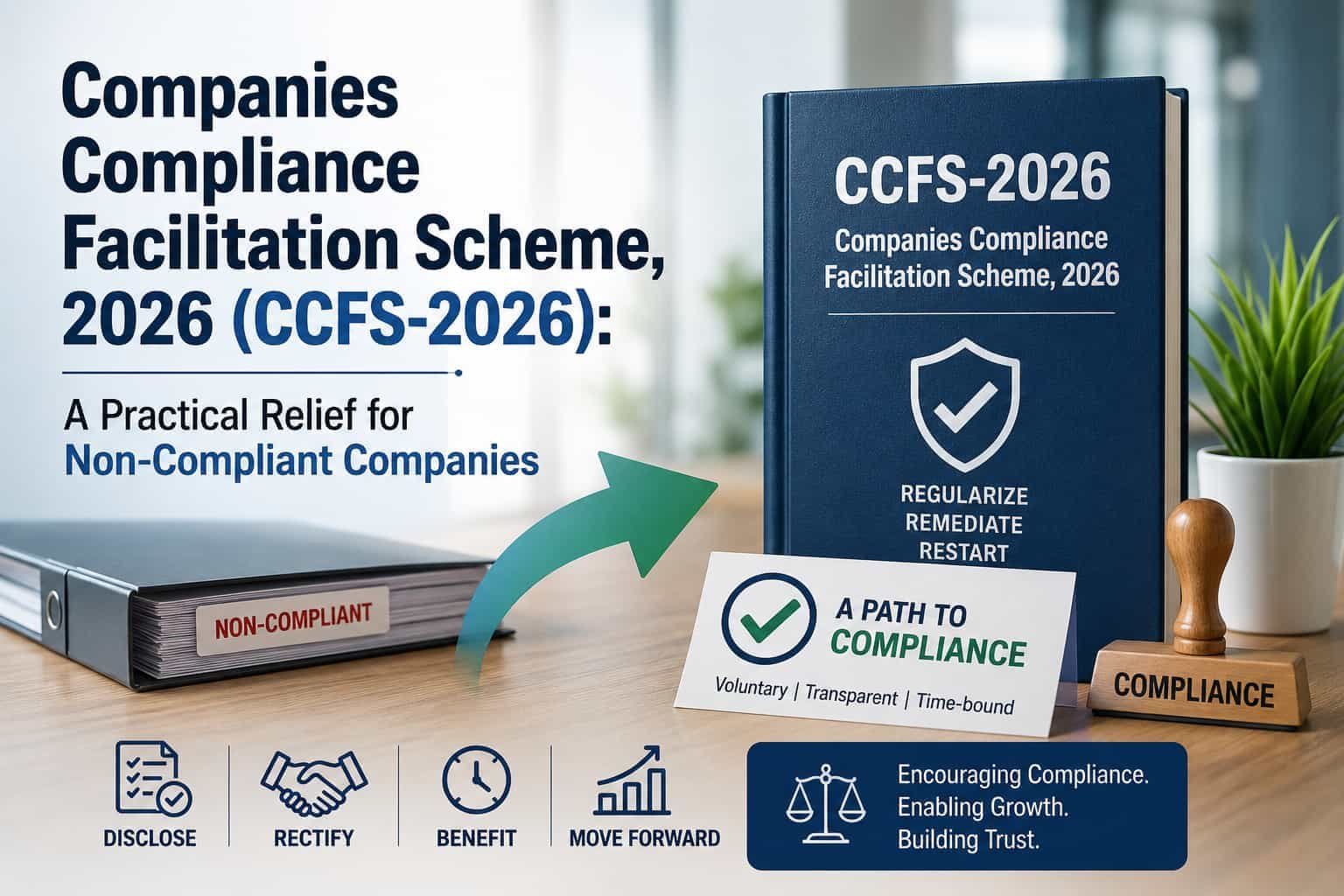
In response to these concerns, the Ministry of Corporate Affairs (MCA) has introduced the Companies Compliance Facilitation Scheme, 2026 (CCFS-2026) through its General Circular dated 24 February 2026. The scheme provides a limited-time opportunity for companies to set their compliance records straight at a much lower cost, while also offering relief from penalties in certain cases.
A Limited Window to Act
The scheme will be in force from 15 April 2026 to 15 July 2026. This three-month period is intended as a one-time compliance window, and companies looking to benefit from it should begin reviewing their pending filings without delay.
Why This Scheme Matters
Under the current framework, delayed filing of annual returns and financial statements attracts an additional fee of ₹100 per day, with no upper limit. For companies with long-pending defaults, this can quickly escalate into a substantial amount.
The CCFS-2026 has been introduced with a clear intent—to ease this burden and encourage companies to come back into compliance, without being weighed down by excessive costs. At the same time, it helps ensure that the MCA registry reflects accurate and updated information.
Options Available to Companies
One of the key strengths of the scheme is its flexibility. Depending on the status and future plans of a company, it can choose from the following options:
1. Regularising Pending Filings
Companies that wish to continue operations can use this opportunity to file their overdue documents, including annual returns and financial statements.
The financial relief here is significant—companies are required to pay the normal filing fees along with only 10% of the additional fees, instead of the full amount otherwise payable. For businesses that have accumulated years of non-compliance, this can translate into substantial savings.
2. Opting for Dormant Status
Some companies may not be actively carrying on business but would still like to retain their corporate existence for future use. In such cases, the scheme allows them to apply for dormant status under Section 455 of the Act.
By filing e-Form MSC-1 and paying just half of the normal filing fee, companies can move into a dormant category where compliance requirements are minimal. This is often a practical option for promoters who want to keep the entity alive without ongoing operational activity.
3. Closing the Company (Strike-Off)
For companies that are no longer functional and have no intention of continuing, the scheme offers a simplified exit route. By filing e-Form STK-2, companies can apply for strike-off by paying only 25% of the prescribed filing fee.
This provides a cost-effective way to formally close entities that would otherwise continue to remain on the register with pending obligations.
Coverage of Forms
The scheme covers a wide range of forms, ensuring that most compliance gaps can be addressed. These include:
- Annual return filings (MGT-7, MGT-7A)
- Financial statements (AOC-4 and its variants, including XBRL and NBFC forms)
- Auditor appointment (ADT-1)
- Foreign company filings (FC-3, FC-4)
- Certain legacy forms under the Companies Act, 1956
This broad coverage allows companies to clear both recent and older pending filings in one go.
Relief from Penalties – With Conditions
Another important feature of the scheme is the possibility of immunity from penalties related to delayed filings.
In general, immunity is available where filings are completed before any notice is issued by the adjudicating authority, or within 30 days from such notice. However, where penalty orders have already been passed, or where the time window after notice has lapsed, the scheme does not provide relief from penalties—though it still reduces the filing cost.
Who Cannot Avail the Scheme
It is equally important to note that the scheme is not available to all companies. It excludes:
- Companies that have already received final strike-off notices
- Companies that have already applied for strike-off
- Companies that obtained dormant status before the scheme
- Companies dissolved through amalgamation
- Vanishing companies
What Happens After the Scheme Ends
Once the scheme closes on 15 July 2026, the regular provisions will apply again. This means:
- Full additional fees will be levied without any reduction
- The Registrar of Companies may initiate action against defaulting companies
- Adjudication proceedings and penalties may follow
In practical terms, companies that do not act within this window may find themselves facing much higher costs and stricter regulatory action.
Final Thoughts
The Companies Compliance Facilitation Scheme, 2026 is not just a regulatory measure—it is a practical opportunity for companies to reset their compliance status without excessive financial strain.
For businesses that have been postponing filings or are unsure about their next steps, this scheme offers a clear and structured way forward. Given the limited timeframe, it would be advisable to act sooner rather than later.
